


Spin-dependent electrochemistry and its applications in clean energy technology
Despite extensive research, the oxygen evolution reaction (OER) remains poorly understood, largely due to spin-related constraints that complicate its mechanism. Electron transport through chiral molecules is spin-dependent, influenced by both the electron’s spin and the molecule’s enantiomer—a phenomenon known as chiral-induced spin selectivity (CISS). This effect has enabled the development of organic spin filters. Our work primarily focuses on chiral organic and hybrid materials, as potential anodes for OER.
For more details, please read our recent work, referenced following.
1. Utkarsh et al., "Chiral supramolecular polymer functionalized two-dimensional transition metal-based catalyst for enhancing the electrochemical water splitting via spin-polarized charge transfer", Journal of Materials Chemistry A, 12 (31), 2024, 20354-20363.
2. Utkarsh et al., “Tailoring the electrocatalytic activity of electrodeposited Co/Fe-based catalyst inducing spin polarization exploiting chiral-induced spin selectivity”, ACS Applied Energy Materials, 8(3), 2025, 1722–1730.
3. Sahu et al., "Metal Organic Frameworks Functionalized with Chiral Architectures for Spin-Selective Oxygen Evolution Reactions", ACS Applied Energy Materials, 9(1), 2026, 698–705.
Our research also focuses on the chiro-magnetic materials that actively help in reducing spin-related bottlenecks by promoting favorable spin alignment during intermediate formation and oxygen-oxygen bond creation. This can potentially lower energy barriers and improve catalytic efficiency beyind individual's thermodynamic limit. We are also investigating the effect of an external magnetic field on OER, which not only modulates the electrode’s spin states but also influences magnetohydrodynamic effects.
For more details, please read our recent work, referenced following.
1. Utkarsh et al., "External Chirality-Driven Interfacial Spin Filtering in Magnetically Aligned NiFe-LDH Facilitates the Enhancement of Oxygen Evolution Reaction", Journal of Materials Chemistry A, DOI: https://doi.org/10.1039/D6TA01446A.
SPIN-CONTROLLED OXYGEN REDUCTION REACTION
We are exploring chiral organic–inorganic materials as spin-polarized catalysts for the oxygen reduction reaction (ORR), a key process in metal–air batteries and regenerative fuel cells. Their performance is evaluated through detailed electrochemical studies using a rotating disk electrode (RDE) to assess and enhance catalytic activity.
For more details, please read our recent work, referenced following.
1. Balo et al., “Advancing Spin-Controlled Electrocatalysis using Chiral Gold Nanoparticles Functionalized Bimetallic Spinel Oxide”, ChemCatChem, 17(7), 2025, e202401695.
2. Balo et al., “Tuning Spin-Polarization of Covalently Coupled CoFe2O4-reduced Graphene Oxide through Chiral Metal Support for Electrochemical Oxygen Reduction", ACS Applied Energy Materials, 8, 2025, 5144−5152.
3. Balo et al., "Induced chirality in metal porphyrin-based biomimetic catalysts promotes ORR activity by enabling spin-polarization effects", Journal of Materials Chemistry A, 2026,14, 11360-11369.
4. Yasmin et al., "Spin-Polarized Electron Transport and Catalytic Enhancement in Chiral Supramolecular Polymer Assemblies", The Journal of Physical Chemistry Letters, 17 (6), 2026, 1630–1639.


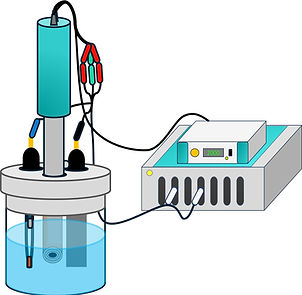
Development of Electrodeposited Organic-Inorganic Hybrid Electrode for Supercapacitor Application
We are developing electrodeposited conducting polymer based hybrid electode to enhance supercapacitor performance. These materials offer tunable structures, high electroactive surface area, and efficient charge transport pathways. As a result, they show improved capacitance, rate capability, and cycling stability for next-generation energy storage applications.
For more details, please read our recent work, referenced following.
1. Barik et al., “Synergistic Enhancement in Electrodeposited Inorganic-Organic Hybrid Materials toward High Energy-Density Asymmetric Supercapacitors," Journal of Energy Storage, 179, 2026, 123731.
2. Barik et al., "Exploring an Electrodeposited Cobalt-based Coordination Polymer for the Advancement of Supercapacitor Performance", Journal of Materials Chemistry C, 13 (46), 2025, 23189-23201.
